|
| The "A-Bomb Dome", Peace Memorial Park, Hiroshima - Photo by MWL |
“If you can get through the museum without tears in your eyes,
then you haven’t felt the message
of Hiroshima.“
June 2010
Anticipation
As I head to the airport for my flight to Tokyo, lots of things are on my mind. A hurricane brewing in the Gulf of Mexico, which could arrive in Texas before I get back. Oil still gushing into the Gulf from the BP blow-out, now almost 70 days ago. And Hiroshima.
I have traveled to Japan 4 times before. Three times in the last 6 months for business, and once at the age of 12, to study Judo. The recent trips have been busy, and have allowed very little time for side-trips. Finally, this time, which is likely my last time, at least as far as this series of business trips goes, I may have an opportunity.
One of the places I would like to visit is Hiroshima. We had a full day to look around Tokyo back in March, and while that’s not nearly enough for Tokyo, I also want to travel west, likely by Shinkansen, to Osaka, Kyoto, or if possible, Hiroshima.
 |
| Office tower, Kawasaki - Photo by MWL |
One feeling I‘ve had on my recent trips is that it’s really hard to rationalize that we, not so long ago, were at War with Japan. All the people I have met, whether hotel staff, people on the street, people in restaurants, and especially my customers here, have been extremely friendly, outgoing, and helpful. My Japanese partners have a great sense of humor, and of course the cultural politeness and hospitality of Japan. So how was it that we two were at war, and such a terrible, costly war, ending in a flash brighter than anyone had ever seen ? It’s just hard for me to imagine.
I’m not a learned student of history. I am however very interested in it, and listen to and watch many sources of information about the past, about the war. I feel that what I understand is likely pretty close to the truth. Of course a search for some full, “real truth” could be pretty fruitless. We just have to put together facts as best we can, and decide for ourselves.
So, as I leave Houston, I’m hoping to find a way to visit more of Japan. I would like to ask my Japanese associate to join me, if he is interested in taking a few days off. He’s a very interesting fellow. We have known each other professionally for many years, perhaps 20. We work for the same global company, and as Sales guys, we see each other at annual sales meetings. But until recently, we had never had the chance to work together jointly on a project. In this case, the project is large and complicated, meaning that several trips to Tokyo have been necessary. Even though we’ve had little time for traveling around and sightseeing, we are frequently having dinners together, and with our partners and customers. During our relaxed dinners, usually with plenty of sake, it’s easy to get My Friend to laughing and the dinners are always most enjoyable.
 |
| Kimono store, Kawasaki - Photo by MWL |
But, we have never approached difficult subjects, like the war. Why it happened, how it ended, if the bombs were necessary. People in our own country will say the bombs were over-kill, were really a demonstration of America’s new weapon, new power, meant more to intimidate our enemies, the Russians, the Chinese. They will say that the bombs were more to punish Japan for the war than to pressure them into ending it. They downplay and dismiss as propaganda the idea that losses from invading the Japanese home islands would have been extremely costly. But I believe to do so, is to ignore, or simply chose to be completely ignorant of, History.
You cannot deny the losses of American Servicemen on Iwo Jima, on Okinawa, all through the pacific, and the losses to the Japanese in those battles were enormous. We all hear too little about the losses suffered by other countries in the earlier years of Japanese expansionism, all through Asia and the South Pacific, but especially in China. How many people in the region were dying every day during that part of the war? Our reason for war was to stop aggression. It had to stop, and at that time, it was up to the U.S. and our allies to stop it. It’s clear to me that invasion would have taken much more time, and would have resulted in far more losses than caused by the bombs.
I am interested to see Hiroshima, interested in visiting such a unique place in History. But I’m still quite reluctant to bring up the subject of the war with My Friend. He is about 10 years older than me, so that would make him in his early sixties, born in the late 1940’s…just after the war. He wasn’t alive during it, and likely doesn’t remember the early post-war years and the reconstruction of Japan. But his parents would have been alive, and perhaps his father, maybe uncles, served in the military.
I will tell him that I want to travel, and invite him to come along. If we go to Hiroshima, the subject of the war will be pretty unavoidable. I hope he can join me. I hope we will find ways to discuss the past, positive ways. I hope.
So, this “road to Hiroshima” begins in Houston. Sunny skies on a warm Saturday morning in June. I zip along the beltway, no traffic, as I consider what this week might hold.
Decision Made
Ok, that’s it, “decision made”. Our original schedule was to meet on Monday and Tuesday, June 28 and 29. Now, from Houston, that meant traveling Saturday morning, arriving Sunday afternoon, to be fresh for a full day Monday. During the evening Monday, I decided not to wait. I would reschedule my departure so that I was available for business Wednesday as well, in case we couldn’t get to the commercial issues earlier. I didn’t want to wait until a time closer to departure to make a quick change. But then, Tuesday afternoon, we got to and finished our commercial discussions. So, since I had extended, I decided to extend a little farther, and take a couple of days off. Unfortunately, my Japanese Partner could not join me, and my Houston Partner headed on home, so I struck out for Hiroshima on my own.
Zoom-Zoom
I had traveled on Japan’s subways and surface trains during recent trips, and during my visit 40 years ago traveled on the first version of the Shinkansen (which we in the US call “Bullet Trains”) at 120 mph. Now however, they zip along at 180 mph (and a new model is coming which will make 210 !!). One conclusion: I love traveling by Shinkansen !! Ticket in my hand,
boarding my train, I face West.
Eager for the Day.
I started the day (very) early, at a hotel near Kawasaki Station, a little south of Tokyo. The regular surface trains are not a convenient place to handle luggage. In smaller stations, you may not find an escalator, and may have to heft your luggage up the stairs. I had a big bag and decided I didn’t want that hassle. I would be returning to a hotel very near Tokyo station, so I “cheated”: I repacked some clothes into two carry-on’s, took a taxi up to the final hotel to leave my bag, and then had a taxi take me right to the entry gate for the Shinkansen Trains. Worked perfectly. I was up at 3:30 am (no big deal for me in this time zone, I wake up that early anyway), out of my hotel by 4:45, bags dropped and to the train station smoothly in time to make the 6:16 Nozomi Express. Easy to buy a ticket, you get an assigned seat, easy to find the track and train, all as smooth as can be.
This is cool ! Japanese countryside, rice paddies,
looking cool in the morning mist as the sun rises behind us.
West we go.
 |
| Passing through a station at "Shinkansen Speed" - MWL |
The trains are really first class. Seats like airline seats, large windows, comfortable, smooth riding, smooth braking at stops. We zipped along at a speed equivalent to the take-off speed of an airliner. We crossed over a truss bridge, a hollow section bridge where we were passing through a “tunnel” of the truss-works. We passed so fast that the eye couldn’t see the truss members !! The light through the window just “flickered” a bit, like an old movie, until we were across. I took a photo as we passed through a station at speed. The lights on the platform are a blur, and you can’t see the people standing a few feet away on the crowded platform ! We were zipping along !!
When we encounter an on-coming Shinkansen train at speed,
we just feel a little "bump" from the air displaced by the other train,
we see a white blur for a few seconds
and a 16-car train (+1600 feet long) flashes by.
Zoom Zoom !
And, it’s Japan. The trains are wonderfully designed, built, operated, and maintained. Spotlessly clean. The young lady selling coffee and snacks and the Conductor bow as they enter and leave the cars. The attendants on the platforms bow towards the passengers as the train comes to a stop.
Hiroshima Castle
 |
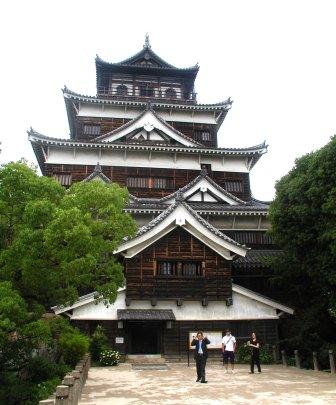
| Tower at Hiroshima Castle - MWL |
I would highly recommend, when you plan your visit to Hiroshima: Do not start at the Memorial. As you will see below, the weight the museum leaves with you is difficult to bear. I recommend a walk first to Hiroshima Castle. It’s a beautiful place, with a moat, Cavalry Grounds, a beautiful shrine and the Osaka Castle Tower. Originally completed in the late 1500’s, the tower was rebuilt in 1958, after the bombing, as a sign to the city and to Japan that Hiroshima was rebuilding, recovering. It’s a museum now. Climb the stairs to several floors of exhibitions, samurai armor, weapons, castle building techniques, and many other cultural items. There are refreshments on the top floor, a cool breeze, and a very nice view of the city and the Hankawa River.
From the Tower, you can see the “A-Bomb Dome”, which makes up the northernmost portion of the memorial. Begin your walk south, and while still on the Castle grounds, you can see a bombed-out bunker that survived the Atomic Bomb blast. In it were members of a local Girls School, who worked at the Communications Center as a part of Japan’s total mobilization for the war. The girls survived the initial blast and it’s believed that they got out the first reports of the attack. There is a tree there that survived the atomic blast. I think that’s a pretty clear signal of the severity of the blast, if monuments are made to the few trees that survived.
Peace Memorial Park
Seeing the Dome – One of the images most closely associated with the Peace Memorial is the so called “A-Bomb Dome”. It was a structure very near the hypocenter (the spot directly under the center of the blast). It forms the northern most point of the memorial and is visible from many points in the city. The park is a long mall of grass, flanked by trees and monuments. The Dome is at one end, the museum at the other. The museum has a full scale model of the dome portion, forming an eerie ceiling in the main room downstairs.
The blast is said to have generated temperatures of from 3000 to 4000 degrees F for a short few seconds. This intense burst of heat, light and radiation is what set the entire area instantly ablaze (a 3 km or 1.9 mile radius from the Hypocenter). The dome was covered by a thin copper sheet, as one sees in many European buildings. The initial heat melted the copper, which partly shielded the iron frame supporting it. A blast shock wave followed the initial heat and radiation burst. Since the blast came from a point nearly directly above the building, the walls were not knocked down. Since the copper was gone, the force of the blast passed right through the empty iron frame, saving it from damage. Instead, the windows were all blown out instantly, and the roof was driven down into the building, collapsing the interior floors. Since the building was relatively small, with relatively thick masonry walls, the walls held. Inside, of course, everyone died.
 |
| Dome replica, in the museum - MWL |
The building was so badly damaged that rebuilding it was not attempted, and at some point it became a centerpiece for the beginning of the memorial. As pressure in the 1950’s grew to finally remove all the old reminders of the blast, it was decided to declare the Dome as a memorial to secure its future.
The Hypocenter - Just about 200 meters east of the Dome is a marker for the “Hypo Center”, the point on the ground directly under the blast-point. This position was deduced and confirmed by comparing blast damage from many points, and noting points either exposed to, or shadowed from, the heat. The marker itself is fairly small and nondescript, sitting just outside some offices operated by the Prefecture government.
 |
| Volunteer guide at the memorial - MWL |
Near the Hypo Center are also several monument stones in a cemetery located almost immediately under the blast. My guide asked me to feel the top of the granite stones, which had been toppled by the blast, but again, since the force was from directly above, the damage was not great. The top surfaces, those facing the blast, are distinctly rough when compared to the other, polished faces of the family monument markers. The searing heat, absorbed more by the darker crystals in the granite than the lighter ones, instantly melted and blew away the dark crystals. But this damage was only a millimeter or so deep, because the heat burst was of such short duration. There are a number of preserved pieces of marble and granite in the museum which had “blast shadows” on them, and thus had the same damaged and spared areas. The shadows are from other objects…or from people.
The Cenotaph – Although I didn’t see it, the museum made reference to the Cenotaph (had to look it up: a monument to the dead, whose bodies are elsewhere). Inside the monument are box after box of lists. Lists of the names of the dead, around 140,000 of them. The names include 10 of the 12 U.S. prisoners of war which were in Hiroshima that morning, and killed in the blast. In later years, the Japanese have reached out to Koreans and others held in Hiroshima by the Japanese at the time of the blast, but later repatriated to their home countries, in an attempt to list their names, track their health status and issues, and assist with their care.
The Mound – Off in the trees on one side of the mall is a relatively small, grass-covered mound. The museum describes the attempt to deal with the bodies of the initial 100,000 dead. They were stacked, literally like wood in the streets, and burned. Cremation is the usual method for burial in Japan. Usually, as I saw near the Hypocenter, there is a small (perhaps 1m x 1m) family memorial. The ashes of family members are placed inside the hollow base of the monument, and their names are added to the stone atop the memorial, similar to gravestones seen in the U.S and other countries. But there were way too many dead after the initial blast for this typical interment. In addition, many families were completely wiped out, leaving no one to see to the ceremonies, inter the remains, to remember. And so the ashes of the large cremation fires were collected and placed in the mound, and covered with earth and grass…about 70,000 of them. (less than the 100,000 because families claimed some, others were simply consumed by the flames, or buried permanently by the rubble).
Seventy Thousand.
The Koreans – Most all of the data and details provided at the memorial and by the Guide Lady at the Dome meshed quite well with details I had encountered in the many movies, books and references to World War II that I have seen. But one key fact had escaped me. At the time of the blast, there were 100,000 Koreans in Hiroshima. 20,000 of them died in the initial explosion. They were forcibly taken from Korea to form work-gangs for the war effort, as were natives of several other countries, including the “comfort women” brought to “serve the needs” of the Japanese military. The Koreans erected a monument to those of their country who died in the blast. It’s an interesting column, riding on the back of a large Turtle, which it the traditional way of depicting souls of Korean dead being transported to heaven.
The Arch – In about the middle of the memorial mall stands the Memorial Arch. It’s only a few meters high, and a few meters across. You can look through it and see the A-Bomb Dome at the end of the memorial. Very near the arch, are an eternal flame and a reflecting pool.
 |
| Looking North, toward the dome - MWL |
 |
| Looking South, toward the museum - MWL |
The Peace Bell – One of the most somber items in the park is a huge, Japanese bell, like you would see in a temple shrine. It’s called the Peace Bell and a sign there invites all who are interested to ring it for Peace. Since it’s a large bell (2m x 2.5 m) it has a beautiful, low-pitched, sorrowful tone, that makes a wonderful, lingering sound as it’s rung, heard all over the park. The tone is a perfect, mournful reminder that brought tears to my eyes as I first heard it rung. I came home and tried to describe it to Brenda, but didn’t even get the word “bell” out before tearing up. I wanted to ring it, but I was there all by myself and, as an American, one of the ones who dropped the bomb in the first place, I felt quite awkward about doing so.
I wish now that I had.
The Museum - Darkest and most difficult of all is the museum. It’s a very nice museum, very nicely arranged. Of course, they begin with background.
Some times I’ve heard people in America argue that the bombing wasn’t necessary, that Hiroshima wasn’t a militarily-significant target. But the information begins with the history of the Japanese 5th Army Division, which was based in Hiroshima, and had headquarters and communication offices in Hiroshima Castle. The division has a history going back to the late 1890’s, before the Russo-Japanese War (1904-1905). During that conflict, the Division was active in various parts of eastern Russia, Korea and China. Their activity in China and Korea continued after that war, into the 1920’s and 1930’s as Japan came into its own as a world power, with a capable navy, and as Japan’s Imperial aggression increased.
Now, the organizers of the museum, to their credit I believe, refrain from being judgmental. They seem to provide the facts, the background, the evidence, and let the visitor draw their own conclusions. I had wondered, as an American, how the fact that America had dropped the bomb would be portrayed. I also wondered how Japanese aggression and cruelty in the run-up to World War II would be portrayed. I felt that the museum, and the memorial in general, did this in a fair, balanced, and non-judgmental way. I hope that my Japanese friends who may read this would have the same impression when they visit.
One striking image at the beginning of the museum displays is a “before and after” diorama showing how the city looked at the time of the blast. Most buildings in the city were constructed of wood and other combustible materials. In a 2 km radius of the blast, all such wooden buildings were set ablaze all at once by the blast, and then flattened by the shock wave. The resulting fire storm consumed much of the rubble of these buildings, leaving a clean-looking, scorched-earth look in the “after” view. In a larger 3 km radius, all wooden structures were set ablaze, though fewer were blown down. This mattered little as the fire storm consumed the structures anyway.
 |
| Target area, "Before" |
 |
| Target area, "After" |
Upstairs are glass cases enclosing the burned and shredded clothing removed from the victims. It brings sharply home the message that all the facts and figures are important in understanding the event, but only a full appreciation of the suffering of the people can convey the impact of what happened here. The clothes are accompanied by a card describing their owner and what happened to them. Many burned so badly that they lingered only hours or a few days before they died. Workers clothing, school uniforms, children’s clothes.
Closer to the end of the displays, you enter a life-sized diorama of bombed out buildings. You turn the corner and come face to face with two life-sized figures, walking like zombies, with their burned hands held out in front of them. It explains that the burns on very sensitive fingers and hands were terribly painful, and that allowing the hands to hang down to one’s sides allowed blood and fluids to accumulate in the fingers and increase the pain. So, as they walked through the rubble, aimlessly seeking water, seeking help, slowly dying, they held their hands up, to do whatever little they could to lessen their suffering.
The Message
As I left The Museum, I felt a terrible weight. They speak, of course, about the numbers, the statistics, the power of the bomb, and how it was made. But their message is the people. The burns, the destruction, the horror. Families lost, bodies unclaimed. Images, frozen in the minds of witnesses. It’s the people that are the message. Death sounds awful, final, the numbers were huge. But the one’s who bore the greatest weight are the ones who didn’t die immediately. Initially, treatment was impossible, as the city tried to regroup. Fires raged, from an entire city set ablaze all in an instant. A Fire Storm erupted, and the fire continued. People tried to flee. Several rivers pass through the city. Everywhere there was water, people sought its coolness, its relief. But badly burned, still surrounded by fire, the water offered little protection. Clustered there, by the thousands, they died. Many of the witnesses drew sketches of what they had seen. Some drew these soon after, and some years later, as they tried to free themselves of these terrible mental images. One drew a sketch of a bridge, and the bodies in the water. He wrote of the side of the page “I have only drawn a few of them, I cannot draw them all, they numbered in the hundreds, and completely filled the river”. Another drew a scene of a person throwing themself into a cistern full of water, about as big as a horse trough. The horror and shock shown on the face of the person as he realized that from the heat of the blast and the fire-storm, the water in the cistern was boiling. The message is the people.
On to Osaka
The next morning, I was up again and headed to the train station. A short walk, and I was back on my favorite form of transportation.
Hiroshima was a powerful, sobering, troubling experience.
I need to head down the road to something “lighter”.
 |
| Nightime Osaka - MWL |
 |
| Ferris wheel atop department store - MWL |
 |
| View from ferris wheel - MWL |
Dinner with My Friend
Saturday night I was back in Tokyo, and met My Friend for dinner. We were able to discuss my visit to Hiroshima, and the war-time issues a bit. We did not discuss them at length really, and given the weight that still hung over me, I was not in the mood to get into much detail about what I had seen.
He had mentioned, prior to my visit, an incident that had occurred in the 1960’s or 1970’s between Japan and North Korea. It seems that North Korean boats had landed in a few isolated places on the Japanese coast, and had abducted 30 or so Japanese citizens. When the Japanese complained about the incident, my friend told me that the Korean reply was “Yes? And what did you do to us?!?” (referring to the Japanese taking of the Korean citizens during the war as forced labor, etc). He clearly acknowledged that the Japanese had been “aggressive” in the past, and that their past behavior was a source of friction between Japan and several of its neighbors still today.
I had wanted to know if there was, in Japanese society in general, an acknowledgement or denial of past “bad behavior” by the Japanese, and it seems that there is indeed this acknowledgement. Intended to prevent a recurrence in the future, the Japanese have tried to construct their constitution, and their military rules of operation, to provide only Defensive forces, to avoid any opportunity for aggressive, offensive action in the future. Clearly, that former aggression had brought about the devastation associated with the war, and post-war Japanese society felt compelled to guard against its resurgence.
But, as I asked about the constitution, he said “yes, they are Defensive forces…but they are still forces. They are supposed to be defensive weapons, but they are still weapons… The challenge is to make sure they remain ‘defensive only’ and are not turned in offensive directions in the future”. I asked if he thought the “aggressive behavior” could be repeated in the future, he said quite readily, “yes, it could, especially by the younger people, less connected to the terrible things that happened in the past”.
Psychology characterizes the causes of aberrant behavior as being either “situational” or “dispositional”. Psychopathic individuals are born with, or naturally caused to have, a predisposition to violent anti-social behavior. But when we speak of a group of people, a nation or a race, we cannot blame some genetic predisposition to violence. People are people. Humans are humans, and if deprived of the effects of socialization, we are more alike that we might suspect. The issue for groups is “situational behavior.” When a group fails to discourage, or even encourages violent anti-social behavior, the individual members are affected to a sometimes surprising extent. This is why otherwise well-behaved individuals become part of an angry mob, or for that matter, part of a government sponsored plan for racial extermination.
We ask ourselves how people could do such things. But in fact, when governments or societies push individuals in a certain direction, the individuals will tend to accept, and then maybe participate in activity that seems not only tolerated, but perhaps is the only acceptable mode of behavior. I firmly believe that the Japanese people are no more violent than any other group of humans (which, perhaps, may not be saying much). But with their cultural norms of conforming with society and honoring superiors and ancestors, perhaps they are a bit more susceptible to being pushed by governmental or societal entities into otherwise unacceptable behavior.
The line between good and evil
is drawn right down the middle
of every one of us.
(uncertain source, but I believe related to the
commentary on the Stanford or Milgram experiments)
On reading a draft of the above, My Friend told me
that he intended to visit Hiroshima again.
He had visited some years ago, but wants to return,
to explore the views of the younger people,
to judge how well they understand the message,
and gage the likelihood
that they can avoid such actions and events in the future.
Conclusions
If you can get through the museum without tears in your eyes, then you haven’t felt the message of Hiroshima. Or perhaps, your connection with history isn’t emotional enough. As therapy, I highly recommend a visit. If you have thoughts, as is the main point of the museum, of trying to assure that tragedies like this never happen again, then I think you are getting the message.
Just by chance, 2 days after my visit, I read about recent agreements between the U.S. and Russia limiting the number of warheads each can possess, to a little over 1500 each. Each ! (and of course, all of them much more powerful than the Hiroshima Bomb) The number hit me and my eyes filled with tears. Quite unexpected. It was the emotion that was unexpected, not the numbers of weapons…prior to my visit I could have already told you approximately what they were.
The use of nuclear weapons: Will it happen again ? Yes, it will. There are too many weapons out there for it not to happen. There are too many rouge states who feel that possession of such weapons will help assure their place on the world stage, in world history. And, we must not forget, the radical, fundamentalist groups for whom the doctrine of Mutual Assured Destruction (M.A.D.) will have no effect. A suicide bomber knows that his death is part of the plan to accomplish his objective. The threat of death is not a deterrent to such individuals, and so the conventional USA-Russia-China status quo, based on the decades old M.A.D. doctrine will not be sufficient.
The only effective solution is the prevention, even at very high cost, of such weapons from ever being developed or obtained by such entities. There are at least two on the horizon right now, North Korea and Iran. Whether you view them as children wielding very dangerous weapons to assert their own power, or serious jihadis for whom Armageddon will set in motion a series of events that will bring about their ultimate goal, we have to keep the weapons out of their hands. Screw their “rights to their own development”, the only way with enough certainty to prevent them from using nuclear weapons, it to prevent them from ever having them.
I am no activist, and I am sure as hell no Liberal. And being a Conservative does not mean that I felt that everything George W. Bush did was right. I didn’t know what to think when he made the decision to invade Iraq. Among the primary reasons given was the possibility of the development, as we all remember, of “weapons of mass destruction” (WMD). In the end, my feeling is this: If we believe that a dangerous country is developing or obtaining nuclear weapons, how can a President, responsibly, not decide to do whatever it takes to prevent it.
Of course begin with diplomacy. Of course begin with the United Nations. But the problem with diplomacy is, it can only squeeze so tight. If the world doesn’t support it one hundred percent (and they never, ever do), then it may not be effective. The problem with the U.N. is that there are too many competing agendas, issues and ideologies. It’s very tough for them to take action, to make tough decisions. Their only course sometimes is to continue to debate, discuss, and propose sanctions.
I don’t personally like the “America-as-Policeman-for-the-World” policies that we have seen the last several decades. For one thing, any action we take to help someone, seems always to make someone else hate us even more. Also, the cost is high, and America shouldn’t be alone in bearing it. But sometimes, there is no one but us who can effectively do anything about a problem. The Russians have had their economic issues, and trust for their policies is “sometimes a problem”. China is large, powerful, but not yet global with respect to exercising military power. The U.N., and as we have seen in Afghanistan, N.A.T.O, have too many competing agendas, and so can also be ineffective.
But America is powerful and global. I found a graphic once showing all the world’s “front-line aircraft carriers,” and the countries to whom they belong. I was immediately struck by the visual. The U.S. operates 24 full-size Aircraft Carriers (and a very large number of lesser ships). The other carriers of the world number only 13, split between 9 other countries, and only one is near the size of the big U.S. carriers. Theodore Roosevelt’s “big stick” (“I speak softly, but I carry a big stick…”) is alive and well, and sailing around the world bearing our flag. So, whether we like it or not, or whether the world likes it or not, somewhere tomorrow, next week, next month, the shit will hit the fan someplace. And there, in the crowd, in the newspapers and online, people will demand: “Where the hell are the Americans, and what are they going to do about this !?!”
If prevention of another Hiroshima is our mission, then like it or not, it is we that will have to go.
- Mark W. Laughlin
August 6, 1945 – 8:15 am
("Hiroshima Time")