Saturday, February 13, 2016

A Complete Step Well...


So, in the prior step well post (http://writtenpost.blogspot.com/2016/01/anatomy-of-step-well.html), I was showing you a well that had partially collapsed, and then was cleaned up and all the debris removed.  The result was a structure you could "see into," one that had been opened up so the supports, the construction, the complexity of it all, could be seen more clearly.

This second well (Adalaj Stepwell, actually the first one we visited that Saturday) is almost completely intact, and so having seen the other, maybe you can understand better what's going on.

Here, I'm standing at a high point, above the place where the steps are just beginning to go down.  I'm facing toward the "well end", you can see the top of the well shaft at the far, upper left of the photo. This well is smaller than the first, maybe half as wide and two-thirds as deep, maybe that helped its survival, as it was built in a similar period.


Here, we have begun to descend, and I've turned to look back up the steps.

In this one, because the structure is fully sound, you can reach the lowest level.  At this moment, with the quiet of a church, you could feel a certain reverence to the place.  As I mentioned in the other post, these places were far more than just wells, as evidenced by the volume of carvings.  They had the look and feel of temples and were likely used as such from time to time.

Here again, we are looking through the several sets of supports.  The ones in this well were closer together along the length, and so a bit more numerous, almost continuous, which may be a reason for their intact condition.
A couple taking advantage of the quiet and the beauty to take wedding photos.

You can see into the lowest part of the well if you look through the arched doorways, to the most distant wall, which is the far side of the well shaft.


From the blue pool, you look up the 6 or 7 levels, to the sky.  Imagine this, after dark, at ceremony time, with people crowded onto every level, candles and torches in hand...


I love to take photos of people taking photos...

...and here the other photographer and his friend are grinning, 
     ...because he is taking a photo of me taking a photo of him.
   
But in a moment, all that chruchly quiet rushed like smoke up out of a chimney...as several busloads of kids, young teens maybe 12 to 15 years old, came in for a visit.  These young ladies were more well behaved and quiet, while their young male counterparts made enough noise to clear the pigeons out of the place (kids are very similar around the world, no matter which language they are speaking !).
We had seen the kids and buses at a local rest stop before arriving at the well.  I'm guessing that they were a school group, making a special Saturday field trip, likely driving from another local town as we had, to see these historic places.  

So, okay, a little noise...but what are these monuments, these things that show us the history of a place, without the interactions we have with the other people that we see, there and along the way. Such places can be cool, but it's the people that make then more interesting, more fun !


And, speaking of people, here's a gentleman we encountered as we drove along the back roads to get to the wells, Just had a second to get the window down and snap.  I like the photo, I just had it printed on metal, for my photo-wall.  ;-)


Next Stop: The Sun Temple !
Y'all take care !
- Mark


Adalaj Stepwell:  In the village of Adalaj, near Ahmedabad, Gujarat, India.  The stepwell was built in 1499 by Muslim king Mohammed Begda for Queen Rani Roopba.
Phone: +91-99428 02787


Saturday, January 23, 2016

Anatomy of a Step Well...


A quick anatomy lesson...
...anatomy that is, of an 11th century step well in India.

In this case, Rani-ki-vav (the Queen's Stepwell) at Patan, Gujarat, India, built about 1050. 
(yes, 1100 years ago !!)

So, this will take a little explanation.  Look to the far end of this "pit", you will see a well shaft.  I suspect that the beginning of the construction of a step well is to first construct the "well".  


The shaft at this site is 30m (98 ft) deep, so it can reach ground water in the dry season, and 10m (32 ft) in diameter.  It's lined in stone, to keep the surrounding soil from collapsing into the hole.  But, as you can imagine, it would be tough for a woman let's say, to lower a rope and bucket 30m into the ground and then pull it back to the top, so they came up with a better idea.


The bricks and smaller smooth stones at the top of the shaft are stones that modern archaeologists used to rebuild portions of the well that had collapsed years ago.  They take the place of original stones that were much more ornately carved, many of which had been removed from the site years earlier.  The original upper portions of the site (the well and the sides of the step area) had collapsed into the well and so, many stones were taken to build other structures in the area.

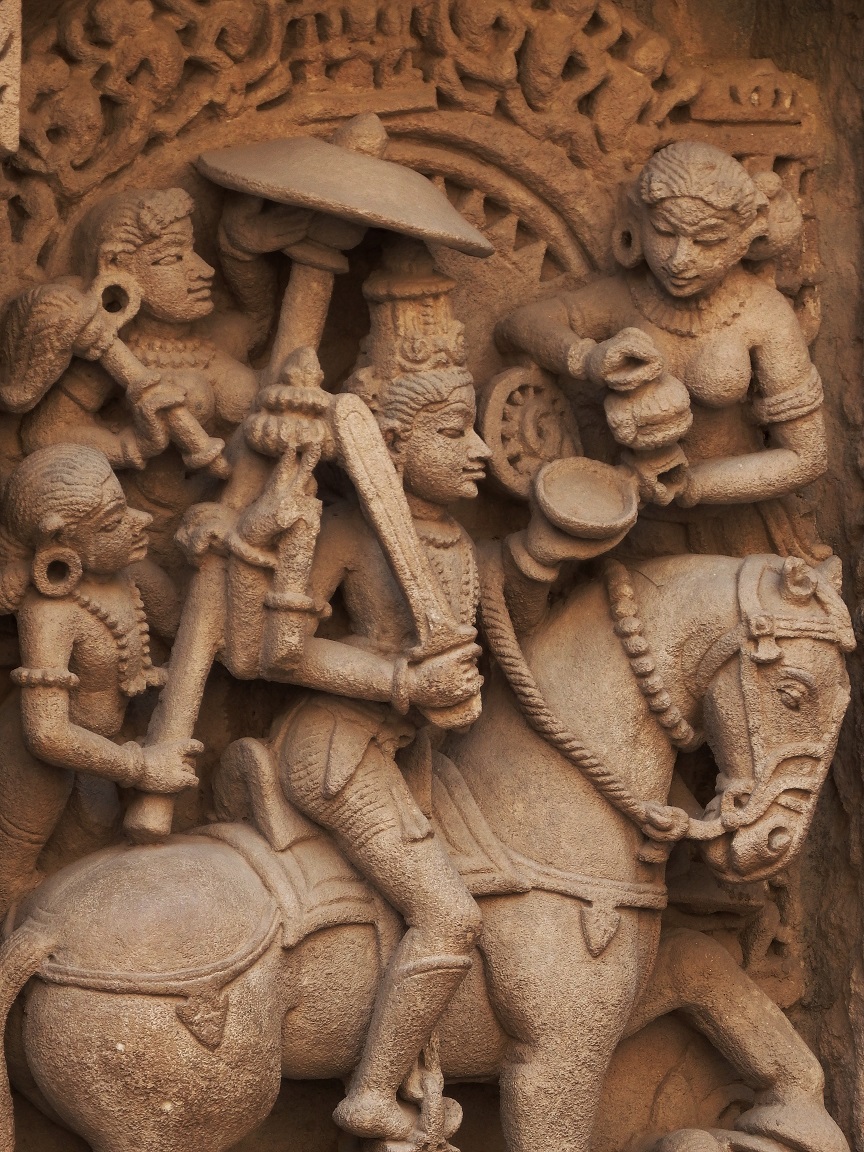
Not only is the detail and intricacy of these carvings amazing (this one is about 1m x 0.7m), the number of them is astounding.  All the surfaces you can see of the original structure are covered with them.

So, now for the "steps".  Imagine that you would like to make some steps down to the water level, which during the dry season, is way down at the bottom of the well shaft.  So, instead of building a smooth brick wall for the entire well-shaft, let's say on the East side of the shaft, starting a few feet up from the bottom, you build a few "Roman-looking" arched doors into the wall of the shaft, one above the other, up the East side of the well shaft (which you can't see in these photos, but will be clear in the next post, with photos taken at a fully-intact well).

Then, you back up a calculated distance to the East, and you start digging a trench, with a bottom that slopes downward, toward the bottom of the well shaft, with an angle similar to the angle of steps.  Walk down the steps until you get to water, and at the bottom levels, you can walk all the way until you reach the "Roman-like" arched doors, and look down into the bottom of the well shaft.

The angle that steps take needs to have a "rise/run" (sorry for the math) that is less than 1, or the step angle is too steep.  So let's say the angle is 0.5/1, you wind up with a 200m long trench with steps reaching down to the 100m level.  But we must remember, this is a trench in possibly loose soil, so we need stone walls to keep the soil from collapsing back in.  We also must support the walls of the trench to keep them from falling inward.  What better force to provide support than the opposite wall.  So "beams" span from wall to wall at multiple levels, to keep the walls straight.  These "beams" are supported by columns, in the above photo, you are looking through the several rows of beams/columns.

 ...with a section of open wall, between each "stack" of columns/beams, 
all, i man all, ornately carved.

 ...beautifully...

Here, I've gone down about a third of the way and turned to look back up the steps.  Our feet are on top of the lowest "beam" in each stack, and we are walking beneath a higher and higher stack of beams/columns are we go further into the trench, and further down the steps.

Everything, walls, beams, columns...all intricately carved.

At this site, since the upper portions were collapsing, they don't let you go all the way down to the bottom, could still be unstable.  Here we are looking through supports that are 3-4 levels up from the very bottom.

In the monsoon season, the ground-water level rises until the entire trench is nearly full, so you might only go down a couple of steps before your feet are wet.  As the season gets drier, you must walk further and further down the steps, until at the height of the dry season, you walk basically all the way to the bottom.  

Many years ago, a nearby river flooded it's banks, silting up the well and step area, contributing to the collapse, and obscuring the site for many years.  Recently, the soil on top has been pulled back, the silt removed from the "trench" and the area made into a national-park-like site maintained by Heritage India so folks can come visit.

Quite cool !

Next, a slightly smaller, but completely intact well, also near Ahmadabad.

These sites are not necessarily "remote" but they are outside the town, and not at all easy to find, unless you have a "secret weapon", which for me is Friends (patient friends that will take time to guide you around, and put up with my slow walking, focusing, clicking...).

Y'all take care,
- Mark


Rani-ki-vav (the Queen's Stepwell) at Patan, Gujarat, India.  Built about 1050. 
Address: Near Patan Patola Heritage Museum, Mohan Nagar Socity, Patan, Gujarat 384265

The fourth level is the deepest and leads into a rectangular tank of 9.5 by 9.4 metres, at a depth of 23 metres. The well is located at the westernmost end of the property and consists of a shaft, 10 metres in diameter and 30 metres deep.


Sunday, December 27, 2015

Northern Limit Line...


I made several trips to Seoul in 2014.  One afternoon, as we successfully finished the days meetings, our partner said he'd like to take us some place.  We dropped our bags at the hotel, and headed over to The War Memorial of Korea.


Photo by Mark W. Laughlin
Beautiful place...huge plaza in front...


Photo by Mark W. Laughlin
...large reflecting pool.


One of the most powerful displays I saw was one that I decided not to photograph.  In one of the main rooms, there is a video display on the walls.  The room light is dim, and it looks like you are standing on a black tile floor.  But when the video ends, the lights start to come up, and lights come on under what turns out to be a glass floor.  Just under my feet were the skeletal remains of a young South Korean soldier, discovered during construction of the museum.  He had been listed as "Missing in Action", but has now been found and identified.  His remains were left just where they were found, with shrapnel and shell casings scattered all around, a dramatic way to demonstrate that this wasn't a far-off, foreign war.  It was local, right there in the city, right there among the homes of the thousands and thousands of civilians trying their best to stay out of the way.  A powerful visual indeed.

During the Korean War (1951-1953), the North swept down through the South initially, before terribly costly fighting pushed them back north.  Seoul is near the middle of the Korean Peninsula, and so it changed hands several times as the sides battled back and forth.


Photo by Mark W. Laughlin
Through all this conflagration, the populace, as shown in this photo in the museum, is left to fend for themselves and try their best to get out of the way of the fighting.  Here, civilians scramble to climb across the jagged structure of a bombed-out bridge over the Han River, near Seoul.


Photo by Mark W. Laughlin
The museum has a large indoor area, full of displays and information.  But they also have a huge outdoor display of the various hardware of war.
Photo by Mark W. Laughlin
A P-38 Mustang...


Photo by Mark W. Laughlin
A Saber Jet...


Photo by Mark W. Laughlin
Even a B-52 Bomber !


Photo by Mark W. Laughlin
...and some of the devices developed to defend against them...


Photo by Mark W. Laughlin
Them notice on the left, suspended above a portion of the reflection pool, is a small ship.


Photo by Mark W. Laughlin
You can go aboard, and as we did, we noticed that it was full of holes !


Photo by Mark W. Laughlin
It seems that this is a replica of a patrol Caravel damaged in an attack by North Korean patrol boats in 2002.  The land boundary between North and South is roughly drawn along the 38th Parallel.  But as you go west, the border changes to the center of a large estuary just north and west of Seoul.  As you reach the coast, the boundary becomes a line in the sea (known as the Northern Limit Line), which the North contends was drawn in an unfair way.  The North still contests the line from time to time, sometimes with artillery fire (as in  2010) or with a naval attack, as in 2002.  I wasn't aware of the details of 2002 until I saw a movie on a flight a few weeks back, called Northern Limit Line.


Photo by Mark W. Laughlin


A gattling gun on the fore-deck...


Photo by Mark W. Laughlin


The bridge...shot full of holes...


Photo by Mark W. Laughlin

You can see my friend Harri walking past stone panels mounted on each column...
Photo by Mark W. Laughlin
...each three characters is a soldiers name... 


Photo by Mark W. Laughlin
...1500 names per panel...


Photo by Mark W. Laughlin
...and there were a LOT of columns, a LOT of panels...


Photo by Mark W. Laughlin
(this is just one wing of the museum...)


Check it out:

The War Memorial of Korea
전쟁기념관
29, Itaewon-ro, Yongsan-gu, Seoul
서울특별시 용산구 이태원로 29 (용산동1가)
Tel: +82-2-709-3139, 3114


Photo by Mark W. Laughlin

My favorite Korean restaurant, and favorite dish...Mackerel !!

- Mark


Friday, December 25, 2015

Be The Match


("replay post") 

Friends, I’d like to suggest something:
Sign up for Be The Match as a possible Bone Marrow Donor.

People who need marrow donation (frequently leukemia patients) need a very close genetic match for the transplant to be successful.  If they do not have a sibling or a good match from a parent, they may be out of luck.

Be The Match is a registry where healthy people can give genetic information (from a simple Cheek Swab kit they will send you) and then have that info entered into a searchable database that doctors can look at to find a match for their patients.  Since it’s hard to find close matches, they need LOTS of volunteers to sign up so the database is large.


If you sign up, and if a patient is found that needs you, the organization will contact you and set up the donation.  There are a couple of different ways to extract the marrow, one easy, one a little less easy, but don’t worry, you can handle it.  While it’s a situation that I do not talk about, I did it before myself.  My sister eventually lost her battle, but one bright spot was the success of the marrow transplant that was attempted. 


So, sign up.  You may never be called, but if you are, you will be giving someone a chance that they simply would not have without YOU.
Do it.
-Mark
   

We lost my sister on 23-December-1983.
I don’t write about her here, it's just too difficult.
Thirty-two years may seem like a long time,
but sometimes, it’s like yesterday.
...
Karen Lynn Laughlin
04-August-1960
23-December-1983
Photo by Mark W. Laughlin

Saturday, November 21, 2015

Raptor visit...an urban bird...


My son brought our "Little One" over to play today.  Just as they were entering the back door, I spotted a very large bird, an obvious bird of prey, on the ground near our back fence. It looked as if he "had something"...


Photo by Mark W. Laughlin

Not sure the gender, so I will just say "he"...he quickly, but without urgency, flew up to a branch just over our patio, only about 12 ft (4m) off the ground.


Photo by Mark W. Laughlin


When I finally got a glimpse of the back end of him, 
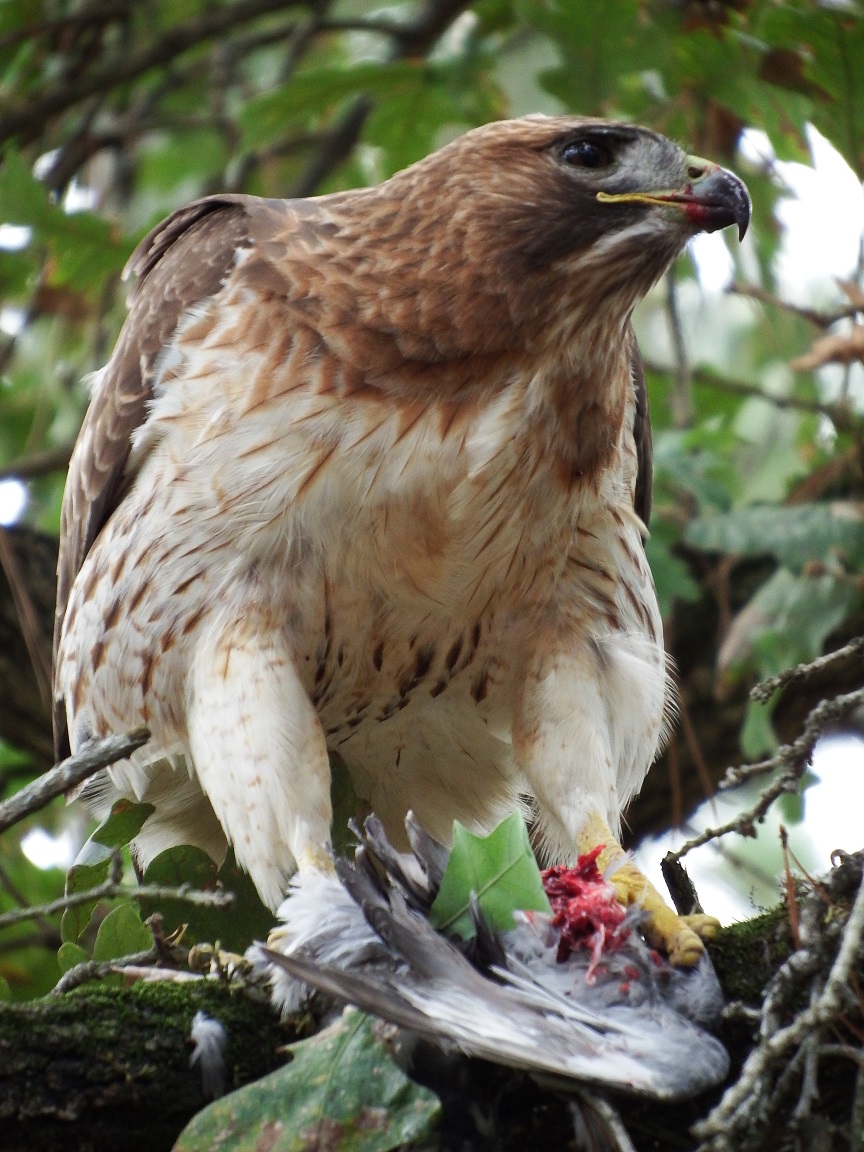
it was clear that he is a Red-tailed Hawk, a rather common hawk in America.


Photo by Mark W. Laughlin
It also soon became clear, from the trail of Pigeon feathers drifting down from his perch, that he'd just caught lunch, and was proceeding to pluck and consume it.


Photo by Mark W. Laughlin
We peered quietly from the garage door for a few minutes, but there were branches in the way from that angle, so I thought I'd try to creep left and improve the view.


Photo by Mark W. Laughlin
He kept an eye on me, but didn't appear particularly nervous.  It took him near a half-hour to pick the carcass clean, and in that time he didn't mind my re-positioning more than once, with my camera at times only 10 or so feet from him.
Photo by Mark W. Laughlin
Not a good day to be a Pigeon.  This fellow must have a taste for them, because several times I have seen feathers or other scraps in the backyard.  If a cat plucks a bird, on the ground, he leaves a rather distinct "pile" of feathers.  But when a raptor is doing the plucking, well up in a tree, the feathers tend to drift over a broader area, easy to distinguish from a "cat kill".
Photo by Mark W. Laughlin
With intent, but without nervousness he continued to pluck and eat.


Photo by Mark W. Laughlin
Munching, and munching...


Photo by Mark W. Laughlin
...watching me, but not much worried about me, 
even though he'd selected a rather low perch, 
which had us almost nose-to-nose.


Photo by Mark W. Laughlin
Finally finishing and attempting to tidy up...


Photo by Mark W. Laughlin
His perch was a nice broad oak branch, so it made a good "table" and nothing of importance fell to the ground...
Photo by Mark W. Laughlin
I suppose he wasn't into eating Pigeon feet...


Photo by Mark W. Laughlin


Recently, I noticed a place, about 20 feet (6m) off the ground in a large tree near the street, where some "critter" has been "cutting" small leaf clusters and dropping them to the ground. I speculated that it might be a large bird, who was opening up the foliage a bit, better to fly in and out of his "home".  It certainly seems plausible that this fellow is the culprit.  


Photo by Mark W. Laughlin
I'll keep an eye out for my very welcome friend, and hope to see him again in the future, but I would never expect to have another "blind-luck" face-to-face photographic opportunity like this !!

Camera handy, batteries charged !!

Y'all take care,
- Mark